Monday, February 13, 2012

When Moses Tragically Failed to Hallow God's Name

                The Lord has been working deeply in my heart so far in 2012 the prayer that Jesus taught his disciples: “Hallowed by your name” (Matthew 6:9).  When we pray that prayer, we are asking the Lord to work in our hearts, and in the hearts of the people around us, in such a way that we will honor him as the holy God he is.  This prayer acknowledges that in order for sinful human beings to hallow God’s name, the Lord must first work his grace in our hearts, so that we do see and love his glory and thus set him apart as holy.

                The Bible, however, regularly sets forth a tension between God’s sovereign work in the human heart on the one hand and human responsibility on the other.  So while we are not surprised to read in Matthew 6:9 that we need to ask God in his grace to enable us to hallow his name, neither are we surprised to read in 1 Peter 3:15 this command to Christians: “[I]n your hearts honor Christ the Lord as holy.” 

Honoring Christ as holy involves loving God and obeying his commands, but today I want to observe a prominent case from the Bible when one of the great saints of the Lord failed to honor God as holy.  I am speaking of Moses, the great man of God the Lord used to lead the people of Israel out of slavery in Egypt into the freedom of the Promised Land.  Numbers 20:2-13 tells the sad story.  The event occurs toward the end of the Israelites’ forty years of wandering in the desert, and once again they are running low on water and complaining about it to Moses.  They are accusing their poor leader of bringing them out into the desert simply to kill them.  This whole scenario had occurred about 40 years earlier, at the beginning of the exodus, and at that time God had instructed Moses to strike a nearby rock, and miraculously the Lord caused water to gush forth from that rock (Exodus 17:1-7).  This time, however, the Lord specifically instructs Moses to speak to the rock, and God promises the water will come forth once again (Numbers 20:8).  However, apparently out of total exasperation with the stubbornness of the Israelites, Moses strikes the rock twice with his staff (Numbers 20:10-11).  And though the rock gives forth water once again, God becomes angry with Moses and disciplines that great man of God.  Moses is now 120 years old, and he has been leading Israel for 40 years.  His greatest desire is to enter into the Promised Land.  Because of his disobedience in the matter of the rock, however, God informs Moses that “you shall not bring this assembly into the land that I have given them” (Numbers 20:12).

                At first glance this punishment by the Lord seems in our human estimation to be a massive overreaction on his part to Moses’ disobedience.  Yes, we acknowledge, Moses did clearly disobey an unambiguous the Lord.  He clearly sinned.  But is striking a rock rather than speaking to it all that serious of a matter?  Why does God get so upset with a man who has been forced to endure so much grief at the hands of his  people for 40 years?

                The Lord gives the reason for his discipline of Moses in Numbers 20:12: “[Y]ou did not believe in me, to uphold me as holy in the eyes of the people.”  In other words, Moses failed to hallow God’s name.  He failed to set apart the Lord as holy in his heart.  He did not uphold the holiness of God before the eyes of the tens of thousands of Israelites who were watching him.

                Perhaps there is more going on in Numbers 20:2-13 than meets our eyes at first.  The Apostle Paul writes in 1 Corinthians 10:4 that in some mysterious way, the rock from which the Israelites drank in the desert was no less than Jesus Christ (1 Corinthians 10:4).  How this is the case is not clear, and this statement of Paul is fraught with mystery.  However, we also know from Hebrews 11:26 that by special revelation from God, Moses had at least some understanding of Jesus who was to come.  If we put all these thoughts together, the Christian writer Edmund Clowney suggests that Moses’ act of striking the rock not only failed to hallow God’s name but in fact deeply dishonored the name of Jesus:


                When Moses struck the rock, a stream of life-giving water poured out into the desert.  When Jesus was crucified, John tells us that blood and water poured from his side (John 19:34). . . . We do not wonder that Moses was judged severely for striking the rock a second time, when he had been told to speak to it (Numbers 20:7-13).  Only once, at the appointed time, does God bear the stroke of our doom.  (Edmund Clowney, The Unfolding Mystery: Discovering Christ in the Old Testament (Philipsburg, Penn.: Presbyterian & Reformed, 1988), 126, emphasis added).


In other words, the act of Moses in striking the rock this second time was such a great offense because he already had struck the rock one time, 40 years earlier, and since the rock represented Jesus, it was to be struck once and only once.  Only one time would Jesus endure the blow for the sins of sinners—at the cross of Calvary.  After his sacrificial death at the cross, Jesus’ work of atonement would be finished (John 19:30), and he would not be struck a second time.  It is at this level that it appears we are to understand the seriousness of Moses’ failure to hallow God’s name in Numbers 20:2-13.

Monday, February 6, 2012

The Love of God in the Heart of the Christian

                Jesus Christ in John 17:26 makes the stunning announcement that the love which God has eternally enjoyed within himself is the same love that he has poured into the hearts of Christians.  From all eternity past, within the one God, the Father has loved the Son and the Spirit with a steadfast, infinite, perfect love; the Son has love the Father and the Spirit with a steadfast, infinite, perfect love; and the Spirit has loved the Father with a steadfast, infinite, perfect love (John 3:35; 5:20; 14:31; 15:9; 17:23, 26).  Jesus proclaims in John 17:26 that it is this same steadfast, infinite, and perfect love that God pours into the hearts of Christians when he makes us his children in Jesus Christ.  To be sure, we will not love perfectly in this world, because sin blocks the full experience of God’s love in our hearts; however, because that love is vitally present in the hearts of Christians, we are able to begin truly to love the Lord our God with all our hearts (Deuteronomy 6:5) and to love our neighbors as ourselves (Leviticus 19:18). 

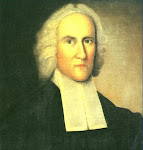
                Jonathan Edwards, the great 18th century American pastor, theologian, and revival leader, preached a sermon in the mid to late 1730’s on the work of this divine love in the hearts of Christians.  Based on 1 John 4:16, the sermon bears the title “The Spirit of True Saints is a Spirit of Divine Love.”  The sermon is typical of Edwards, a man in whose mind and heart the Lord brought together a surpassingly sharp intellect with deeply passionate love to God.  Edwards lived and breathed and preached and wrote so that all people would know the majesty and beauty of God and would find the deepest longings of their souls quenched in God’s glory alone.  The sermon on 1 John 4:16 is quite lengthy, so I want here to excerpt just a handful of quotes, along with a word of explanation concerning the context of each quote:


(The love of God in the heart of the Christian produces deep longing for the Lord.) “A true saint in his esteem exalts God above all.  He is in his account the most excellent, the most glorious being.  The saint esteems God so great and excellent as to be worthy of all that he requires.  He accounts him worthy of all obedience, of all praise and glory.  He accounts him worthy of the most humble addresses and worthy that he should give himself to him.”


(The love of God in the heart of the Christian produces esteem and honor for his or her neighbors.)  “It is the tendency of this divine principle to honor natural men for that natural image of God that is in them and for their natural excellencies, their natural knowledge, wisdom, and the like.  And to honor them for their outward dignities.”


(The love of God in the heart of the Christian produces a love for the attributes of God, even those attributes with which we as human beings sometimes struggle, like God’s sovereignty.)  “But owning the sovereignty of God is what the saints take delight in.  They see that God is worthy to be sovereign, that he is worthy to have the absolute domination over all creatures and disposes all things according to his own please and to make himself his end.  A godly man can rest and be pleased in it.  He loves to have God sovereign.”


(The love of God in the heart of the Christian produces a love for God for his own sake and not first for what the Lord does for us.)  “True divine love is not so much because of the kindness that we have received of him as for himself, not so much for our sakes as for his own sake. . . . [A] true Christian loves God for himself because he sees him to be worthy of all love, not that he does and ought to love God for his benefits, but that this is not the only foundation of his love, but he loves him for his own excellency, for his own glorious nature whereby he esteems him worthy of the highest love.”  


Jonathan Edwards, “The Spirit of the True Saints is a Spirit of Divine Love,” in The Glory and Honor of God: Previously Unpublished Sermons of Jonathan Edwards, vol. 2, Michael D.  McMullen, ed. (Nashville, Tenn.: Broadman & Holman, 2004), 301-02, 320-21, 323.

Commentary on the Susan G Komen Foundation and Planned Parenthood

Russell Moore is a friend who is dean of the Southern Baptist Theological Seminary in Louisville, Kentucky.  Dr. Moore has written a penetrating and convicting analysis for the Christianity Today web site concerning the decisions made last week by the Susan G. Komen Foundation concerning its financial support of Planned Parenthood.  The church really needs to hear Dr. Moore’s challenge in this piece, the link for which appears below.


http://www.christianitytoday.com/ct/2012/februaryweb-only/bad-komen-lessons.html


Wednesday, February 1, 2012

Radical Dependence on God

                Leviticus 25:1-7 records the Lord’s instructions concerning the “Sabbath Year” his people the Jews were to observe.  “For six years you shall sow your field, and for six years you shall prune your vineyard and gather in its fruits, but in the seventh year there shall be a Sabbath of solemn rest for the land, a Sabbath to the Lord.  You shall not sow your field or prune your vineyard” (vv. 3-4).  Instead of the Israelites planting and harvesting their own crops in that seventh year, the Lord himself promised to supply the food his people would need (vv. 6-7).

                Why would God give such an odd command to his people?  Some agriculture experts might suggest God was seeking to preserve the fertility of the land by commanding that it lie fallow once every seven years.  That is perhaps part of the Lord’s reasoning, but retaining the fertility of the soil was not his main goal in ordering observation of the Sabbath Year.  It is clear that once again God was seeking to teach his people total dependence on him for everything they needed, even their food.  By having to trust God for a full year, without planting any crops, the people would grow in faith, for they would indeed see the Lord provide their needs.

                The problem is that there is no record in the Old Testament that the Israelites ever observed the Sabbath Year of Leviticus 25:1-7—not even once.  To the contrary, 2 Chronicles 36:21 hints that the Jews never observed the Sabbath Year at all after they entered the Promised Land.  Undoubtedly the reason why was a failure to take God at his word; they failed to trust the Lord for provision of food during the year their land was supposed to lie fallow.

                God loves his glory.  One of the main ways that we glorify the Lord is by depending on him totally for all things, even the food we put on our tables, for when we do depend totally on God, we are showing the world around us that he is altogether true and trustworthy.  Take time today to think of some area of your life in which you really are not depending totally on the Lord.  Maybe you do not really depend on the Lord to provide the income your family needs, because you do not actually trust God to provide that income.  Perhaps you withhold the tithe precisely because of this failure to depend totally on the Lord.  As God puts his finger on some area of non-dependence in your life, confess that sin and ask God to cleanse you from it (1 John 1:9).  Then seek the grace of the Holy Spirit to depend on and trust in the Lord “with all your heart” (Proverbs 3:5-6).    

Tuesday, January 31, 2012

The Bible's Teaching on the Sanctity of Human Life

                Someone on Sunday asked that I post the outline I have developed through many years on the biblical teaching about the sanctity of human life from conception to natural death.  I am happy to do so, and I do so with thanks to God for his clear words on this subject in Holy Scripture.


“What The Bible Says About Abortion and

the Sanctity of Human Life”

Sanctity of Human Life Sunday 2012

Prepared by Stephen E. Farish, Pastor


I.                    principles from the Bible touching on the question of abortion

a.      God asserts that he alone has the sovereign right to decide matters of life and death (Deuteronomy 32:39).

b.      We are not autonomous in the use of our bodies; that is, we cannot do with our bodies whatever we choose to do.  The Bible does not affirm a “right to choose” an abortion (Acts 17:28; 1 Corinthians 6:18-20).

c.       God is the Author of all human life (Genesis 2:4-7; Psalm 139:13-16; Acts 17:28; etc.).

d.      God places a very high value on human life because he has stamped us with his image (Genesis 1:26-27; 9:4-6; James 3:9).

                                                  i.      Genesis 1:26-27 and the creation of human beings in God’s image is the principle that spurred the Civil Rights movement of the 1950’s-1970’s, especially in the mind of Martin Luther King, Jr.

e.       God condemns the taking of innocent human life (Genesis 9:4-6; Exodus 20:13, the Sixth Commandment).

f.        Jesus commands that we work to save and improve the lives of others (Matthew 5:21-22).

g.      The Bible views life as being on a continuum that begins at conception and ends at death (Psalms 51:5; 139:13-16).

                                                  i.      Other passages that indicate God deals actively with babies in the womb, which indicates they are human beings and not “blobs of protoplasm” or “the product of conception” (Psalm 51:5, David a moral being at conception; Isaiah 49:1-2, 5; Jeremiah 1:4-5; Luke 1:41-44; Judges 13:5-6).

h.      God affirms the sanctity of prenatal life in that he himself became a baby in the womb in the Incarnation of Jesus Christ (John 1:1, 14; Luke 1:35).

i.        The Old Testament Law of God treated a baby in the womb as a human being and prescribed the same penalties for hurting a person inside the womb as a person outside the womb (Exodus 21:22-25).

j.        The Bible calls babies in the womb “children” in Exodus 21:22 and Luke 1:41, 44, using the Hebrew word yeled and Greek word brephos.

k.      God loves all human beings (John 3:16), including unborn human beings, and he wants us to be like him, by his grace, in this love (Ephesians 5:1).


II.                 The testimony of the science of genetics confirms that the biblical view of when life begins is neither irrational nor unsicientific.

a.      “Since species-specific DNA strands, identifying the fertilized egg as human, are present at conception, a human person with rights is present at conception.”[1] 

b.      “When the sperm and egg unite, a genetically unique human being comes into being.  While the developing child is dependent on the mother’s body for nourishment and oxygen, physiologically the unborn child is not simply a part or extension of the mother’s body.  The unborn child is an individual in his or her own right, with a separate and distinct life trajectory.”[2]


III.               So what should a follower of Jesus do, with and by God’s grace, to help promote the sanctity of human life?

a.      cultivate respect for all other human beings, regardless of age, race, nationality or abilities

b.      warn our society about God’s attitude toward the our sin (Ezekiel 3:16-19)

c.       seek to change our laws so that all people, born and unborn, receive justice (Jeremiah 21:12; Luke 11:42; Amos 5:21-24; etc.)

d.      help provide legitimate alternatives for women seeking abortions, by support of ministries like local crisis pregnancy centers or Teen Mother Choices (through prayer, volunteering, and financial support)

e.       point women who have undergone abortions (and the men who encouraged them) to the forgivness and healing power found only in God’s grace in Jesus Christ

f.        support and practice adoption, as the Lord leads

g.      work for the respect of human life at the end of life too

h.      pray (and perhaps fast), asking God to end abortion in this land

i.        pray that the Lord would raise up judges of righteousness who would overturn Roe v. Wade and who would protect preborn life

j.        proclaim the gospel faithfully in a dark world (Romans 1:16)—we can change minds ultimately, by God’s grace, through the gospel alone


IV.              For more information, see the following web sites:

a.      www.nrlc.org (web site for National Right to Life Committee)

b.      www.cbhd.org (web site for the Center for Bioethics and Human Dignity at Trinity International University)

c.       www.family.org (web site for Focus on the Family)


V.                 Two statements from The Baptist Faith & Message (2000), the official statement of faith of Crossroads Church and of the Southern Baptist Convention:

a.      “Children, from the moment of conception, are a blessing and heritage from the Lord” (paragraph XVIII).

b.      “We [Christians] should speak on behalf of the unborn and contend for the sanctity of human life from conception to natural death” (paragraph XV). 


[1] John Feinberg and Paul Feinberg, Ethics for a Brave New World (Wheaton: Crossway Books, 1992), 60.

[2] John Jefferson Davis, Evangelical Ethics, 2nd ed. (Phillipsburg, N.J.: Presbyterian & Reformed, 1993), 135.

Thursday, January 26, 2012

"Christus Victor"

This past Sunday I preached from Mark 5:1-20 on the stunning account of Jesus’ deliverance of a particular man from a horrific case of demon possession.  While I did place the passage in its context in the Gospel of Mark, I did not have time to set the account in the larger context of the biblical storyline as a whole.  Placing Mark 5:1-20 in its overall biblical context, albeit in a general way, is what I wish to do with today’s blog posting.

Mark 5:1-20 is in the Bible, among other reasons, to advance the theme of “Christus Victor,” a Latin phrase the church uses to describe God’s absolute triumph, in Jesus Christ, over the devil and his demons.  Consider the following biblical “timeline” of this “Christus Victor” theme:


1.       Genesis 1:27; 3:1- At some point between the time God finishes his original work of creation and pronounces it very good, and the time Satan appears in the Garden of Eden to tempt Adam and Eve to sin, the devil and his demons rebelled against God and fell forever from the glory of heaven.  (See Isaiah 14:12-20, which appears to describe both the rebellion and fall of the earthy king of Babylon and the original rebellion and fall of Satan and his demons.)


2.       Genesis 3:15- No sooner does mankind sin than his loving Creator promises to send one day an “offspring” of the woman who will destroy the power of the devil, though in the process the “offspring” himself will suffer wounds.


3.       Matthew 4:1-11- Jesus comes as the “offspring” promised in Genesis 3:15, and he begins to defeat the power of Satan by resisting completely the devil’s best attempts to tempt him to sin.


4.       Mark 5:1-20- Jesus continues to demonstrate his power over the devil and, in this case, over a “legion” of demons.  This passage makes it clear that when Jesus speaks, his voice is the voice of God, and demons have no choice but to do exactly what God says when he commands them, because God is their Creator and ultimate Ruler.  The devil and his demons are totally under God’s supreme authority.


5.       Colossians 2:13-15- Jesus triumphed over the devil at the cross.  The Lord won a decisive victory over the Adversary through his death for sinners, because through that sacrificial death, Jesus sets free forever all of his people from the power of the devil.  What looked on the surface like God’s greatest defeat—the death of his Son—in reality was the hour of supreme triumph, not just over the devil but also over sin and death.


6.       Revelation 20:7-10- Jesus dealt Satan and his demons a decisive defeat at the cross, in such a way that the devil’s final defeat is certain.  At the end of the age, Jesus will fully and finally defeat Satan and his demons and throw them forever into the “lake of fire,” so that in the new heavens and new earth, Christians will be free forever from any attempts by Satan and his demons to harm them.


So what is the practical aspect of this “Christus Victor” theme to the lives of Christians today?    As one Christian writer put it in a popular book several decades ago, we need to be aware that for now, Satan really is alive and well on planet earth.  He cannot take away the salvation of Christians (John 10:28-30), but he still seeks to do Christians any harm he can (1 Peter 5:8), primarily by tempting us to sin and thereby ruining our witness to the world of the saving power of Jesus Christ.  However, the “Christus Victor” theme reminds us that the Jesus who lives in Christians spiritually has infinitely greater power than the devil, and Satan is under a death sentence because of the cross of Christ (cf. 1 John 4:4).   We have the power, by the grace of God, to defeat any schemes of the Adversary to do us harm.  We can resist him, in the power of Jesus who has defeated him (1 Peter 5:9), and he will flee from us (James 4:7).  Let us therefore pray that God will cause the power of Jesus to enable us to see and defeat any scheme of the devil to do us harm.  And let us remember that this power of Jesus in us is the same power that already has triumphed over Satan in Jesus’ life and death.  Thanks be to God for the power of his grace at work in his people!

Tuesday, October 26, 2010

Remembering St. Crispin's Day

Yesterday was St. Crispin’s Day, and if you remember your English history, it was the anniversary of the great battle of Agincourt (1415, the Hundred Years’ War).  Below you will find my favorite lines from Shakespeare’s Henry V (act 4, scene 8), in which that godly English monarch gives all the glory to God for the amazing English victory that day over the French.  I cannot imagine an American president today saying anything remotely close to these lines.  See especially the lines I have highlighted.


This note doth tell me of ten thousand French

That in the field lie slain: of princes, in this number,


And nobles bearing banners, there lie dead

 80


http://tags.bluekai.com/site/357

One hundred twenty six: added to these,


Of knights, esquires, and gallant gentlemen,


Eight thousand and four hundred; of the which,


Five hundred were but yesterday dubb'd knights:


So that, in these ten thousand they have lost,

 85


There are but sixteen hundred mercenaries;


The rest are princes, barons, lords, knights, squires,


And gentlemen of blood and quality.


The names of those their nobles that lie dead:


Charles Delabreth, high constable of France;

 90


Jaques of Chatillon, admiral of France;


The master of the cross-bows, Lord Rambures;


Great Master of France, the brave Sir Guichard Dolphin,


John Duke of Alencon, Anthony Duke of Brabant,


The brother of the Duke of Burgundy,

 95


And Edward Duke of Bar: of lusty earls,


Grandpre and Roussi, Fauconberg and Foix,


Beaumont and Marle, Vaudemont and Lestrale.


Here was a royal fellowship of death!


Where is the number of our English dead?

 100


Herald shews him another paper


Edward the Duke of York, the Earl of Suffolk,


Sir Richard Ketly, Davy Gam, esquire:


None else of name; and of all other men


But five and twenty. O God, thy arm was here;


And not to us, but to thy arm alone,

 105


Ascribe we all! When, without stratagem,


But in plain shock and even play of battle,


Was ever known so great and little loss


On one part and on the other? Take it, God,


For it is none but thine!